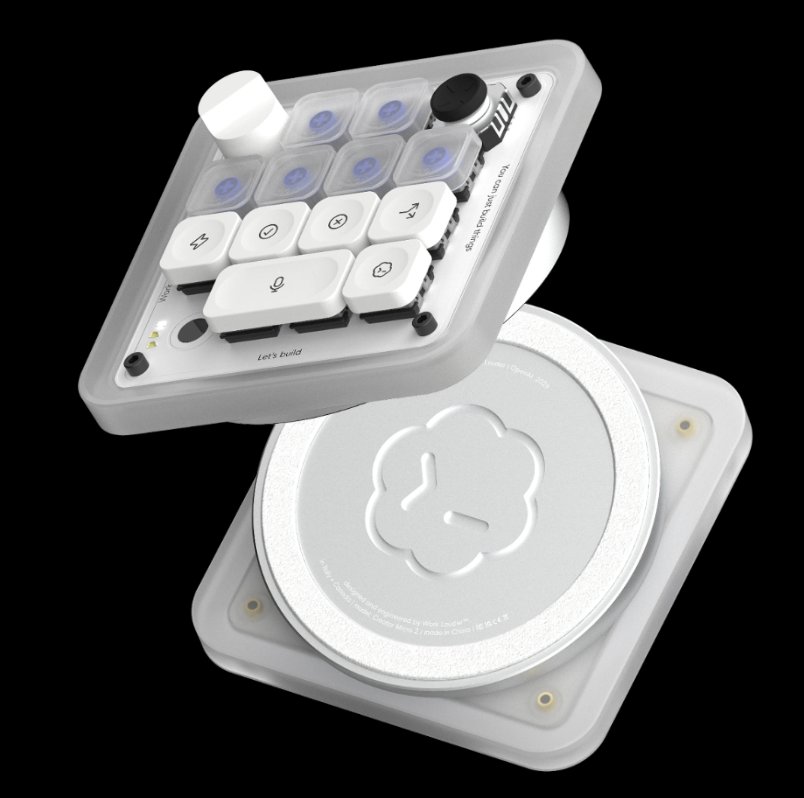
If you saw headlines about 'ChatGPT's new keyboard' and went looking for a phone app, you're not going to find one. OpenAI hasn't released a software keyboard for iOS or Android. What they actually launched is something much more niche: a physical $230 mechanical macropad called the Codex Micro, built for people who use OpenAI's Codex AI coding tool all day. Here's what it is, what it does, and whether it's remotely relevant to you.
What the Codex Micro actually is (and isn't)
The Codex Micro is a small physical keyboard accessory, think a chunky little control pad that sits next to your regular keyboard, not a replacement for it. OpenAI made it in collaboration with Work Louder, a specialty keyboard company, and according to The New Stack it shares hardware roots with Work Louder's existing Creator Micro 2 (though how much is genuinely new versus carried over isn't something OpenAI or Work Louder have spelled out publicly).
It's built entirely around Codex, OpenAI's AI coding agent, not the general ChatGPT you use for conversation. The point is to give developers a dedicated physical interface for managing AI coding tasks without constantly tabbing back to a browser window.
The hardware itself is genuinely interesting: six frosted light-up 'Agent Keys' that glow different colors depending on what your AI agents are doing (white for idle, blue for thinking, green for done, red for something went wrong), a rotary dial for adjusting reasoning levels, a joystick for triggering common coding workflows like reviewing a pull request or debugging an error, and a handful of Command Keys for things like accepting or rejecting AI suggestions. All together there are 13 mechanical switches (your choice of clicky or silent). It connects via Bluetooth or USB-C and is configurable through both the ChatGPT desktop app and Work Louder's own Input app, which gives you access to additional layers and customization.
It is not a mobile keyboard. It doesn't work with your phone. It has nothing to do with typing in apps, rewriting text, or any of the features you'd expect from a smartphone keyboard extension.
 Codex Micro by OpenAI × Work Louder →
Who this is actually for (and a note on mobile keyboards)
Honestly? The Codex Micro is for a pretty specific person: a developer who uses Codex heavily, runs multiple AI coding agents in parallel, and finds the context-switching between tasks annoying enough to spend $230 on a physical shortcut pad. Codex has a substantial user base (The New Stack put the number around 9 million, though that figure isn't sourced to an official OpenAI statement), so it's not a tiny audience, but this is still not a general consumer product.
If you're a writer, designer, musician, or anyone who just wants AI help while typing on your phone, this product isn't for you, and there's no official OpenAI alternative to point you toward. Third-party apps do offer ChatGPT-powered keyboard extensions for iOS and Android via the API, but those aren't OpenAI products. Worth knowing the difference before you hand over your keystrokes to something unofficial.
For Codex users who are curious: the keyboard is available to order now at $230 from both OpenAI and Work Louder's site, with first units expected to ship later in July 2026. Stock is described as limited. Double-check current availability before you commit, OpenAI framed this as a limited-run collaboration, not a permanent product line.
The 'ChatGPT keyboard' story turned out to be a case where the headline traveled further than the actual product deserved. The Codex Micro is a real, interesting piece of hardware, just a very specific one for a very specific workflow. If you're a developer deep in Codex, it might genuinely be useful. If you heard 'keyboard' and hoped for something that helps you write better texts or emails on your phone, that product simply doesn't exist yet from OpenAI.